

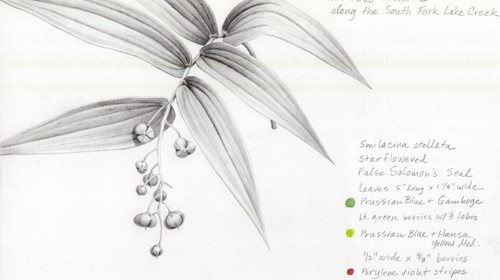
I recently spent a weekend hiking and sketching in eastern Oregon with a group from Oregon Botanical Artists. The weekend was generously hosted by two eastern Oregon botanical artists so we could get to know one another better. We spent the first day sketching at an area called the Metolius Preserve, where an effort is being made to preserve and restore an old growth Ponderosa pine forest. Since the day was rather hot, I found a shady spot near a stream where the plants grew green and thick to draw the berries and leaves of a Star-flowered False Solomon’s Seal, Smilacina stellata.
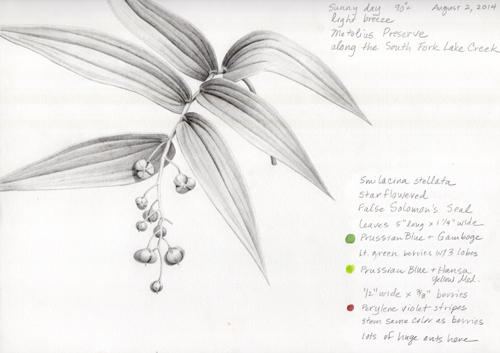
I did a graphite line drawing of Star Flowered Solomon Seal leaves and berries in the field. Then I finished the shading in my studio from reference photos because not only did I run out of time but was being over run by rather large ants!
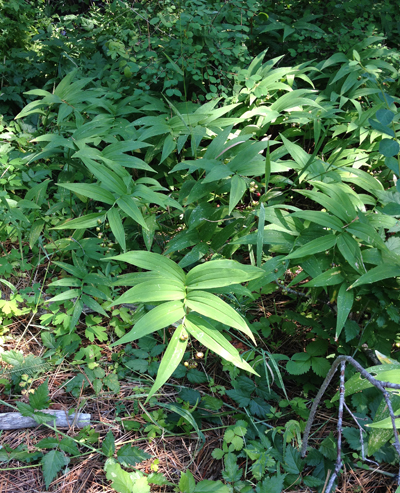
Star Flowered False Solomon Seal growing along a stream in the Metolius Preserve.
For those of you unfamiliar with Oregon’s topography, eastern Oregon is high desert, separated from from the rainy west side, where I live and where OBA meets, by the Cascade Mountain range. On the east side of the mountains, dried grass and sagebrush mingle with sparse stands of Ponderosa pine and juniper, while on the west side lush forests of Douglas fir predominate. While there is some overlap, in general the ecosystems are quite different.
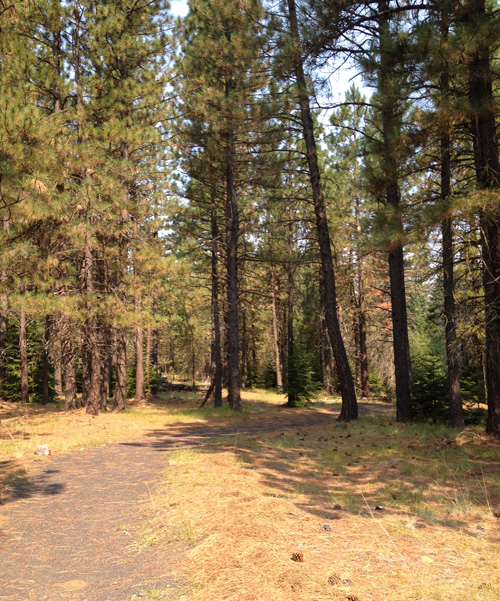
The dry Ponderosa pine forest in the Metolius preserve.
The next day we took the Canyon Creek Meadow Hike, which wends its way through another Ponderosa pine forest, under the shadow of one of the dormant volcanoes that make up the Cascade Mountain Range. The trail followed a stream for awhile, passed several small lakes, then brought us to meadows with a view of of the craggy mountain called Three Fingered Jack.
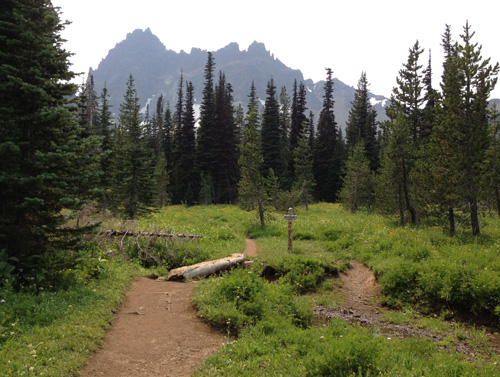
Meadow with Three Fingered Jack in the background.
At this higher elevation there was a surprising number of wildflowers still in bloom. We spent a lot of time hunched over an array of dazzling but miniscule beauties alongside the trail.
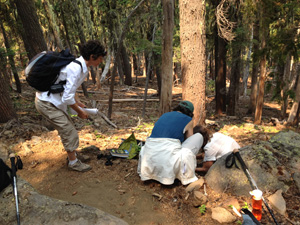
Identifying and taking photos of a tiny treasure along the path.
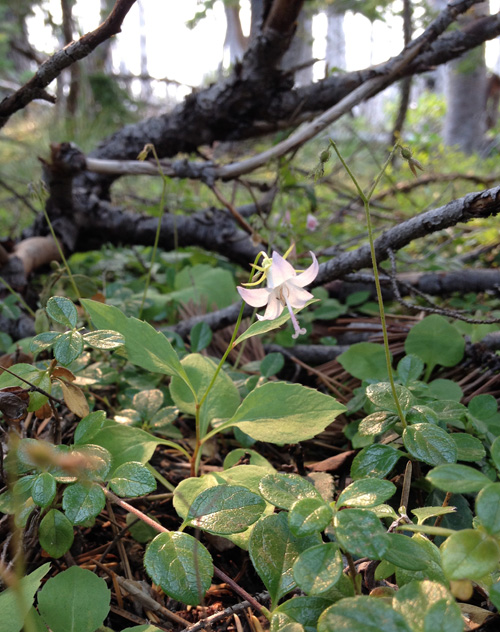
Scouler’s Harebell, about 4 inches tall (10 cm) along the trail.
This is where I met some old friends, but this time in their native habitat. We came across a lovely stand of Cascade Penstemon, Penstemon serrulatus, which was dramatically perched between huge boulders above the trail.
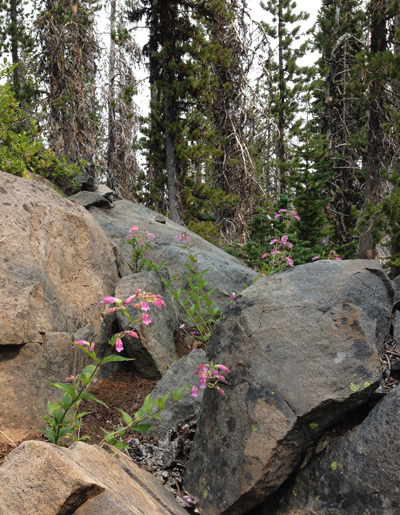
Cascade Penstemon nestled in the boulders above the trail. I climbed up a ways to get this photo.
I illustrated both a leaf and a flower from this plant during the SBA course for the “leaf assignment” and the “flower assignment”, way back near the beginning of the course.
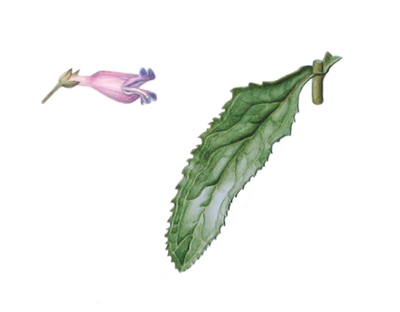
Cascade Penstemon leaf and blossom that I painted as part of my third and fourth SBA assignment, respectively. The flower changes color from pink to blue overtones as it ages.
Because of time constraints during the course, I couldn’t always search out a specimen to study in its native habitat, but usually purchased one from a nursery specializing in native plants. My purchased plant is now thriving in my garden and is even propagating itself nicely, so I should have some to give away soon. Although I know the plant fairly well, I found it stunning in its rocky, dry home in the forest.
The next ‘old friend’ I met was a Corn Lily, Veratrum viride, which I have long desired to know better. I painted a leaf from a small nursery specimen for my SBA leaf assignment but had not yet seen the plant in flower or in its native environment. It’s another stunning beauty that I want to study and paint in greater detail in the future.
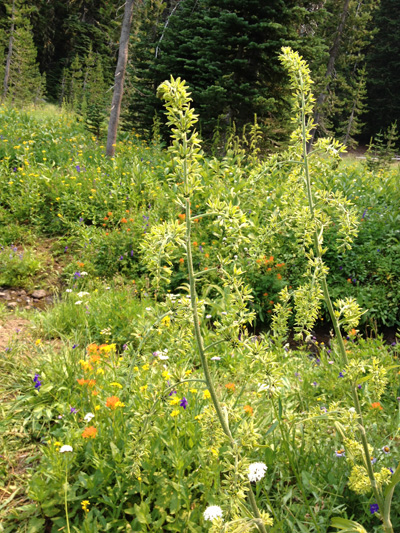
Blossoms of Corn Lily in a meadow near Three Fingered Jack
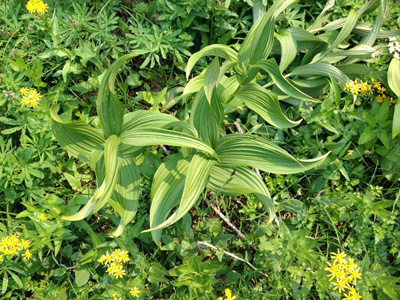
The accordion-pleated leaves of Corn Lily swirling around the stem.
It was delightful to become better acquainted with some of my fellow botanical artists, and strangely, I felt as if I had run into old friends along the trail when I spotted plants I had studied and painted in past years. Seeing them in their native habitat opened future possibilities of portraying them in a way that includes something about their native ecosystem, like the setting, the pollinating insects or companion plants.
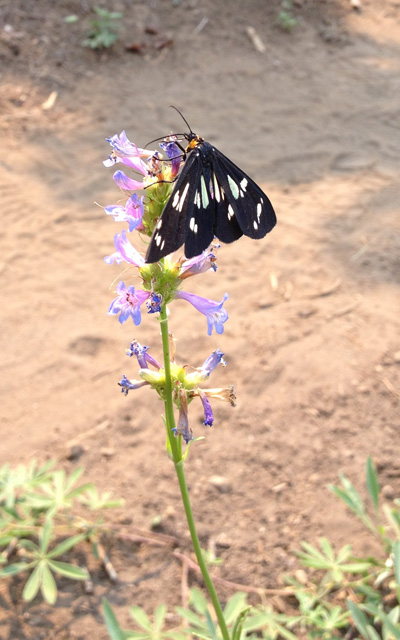
A Tiger Moth perching on a Penstemon along the trail.
Am I the only one, or do you develop an attachment to plants or scenes that you have drawn or painted?


 This blog is about my journey as a botanical artist--what I am learning, what inspires me and what I am currently drawing or painting. My desire is to continually hone my skills to better express my wonder and gratitude for the beauty of the creation around me in the Pacific Northwest (USA).
Lovely blog Janene- just the right touch. You have me thinking about my attachments to plants I think I develop an attachment to plants for various reasons, some have childhood memories, others I’ve grown and/or drawn. One thing I know for sure is – once I draw a plant I don’t forget it.
So true, Aislinn–drawing a plant or even a part of it, is a great aid to my memory of it. And my memory needs all the help it can get!
This is a really lovely, informative post Janene. Thank you for introducing me to loads of the gorgeous species that you found and the countryside is just awe-inspiring. Great sketches too. x
Thanks, Jarnie–glad you enjoyed the post! x
Janene, your post is lovely and you make me want to get over to Three Fingered Jack while all these flowers are in bloom. I hope you get to draw some more of them too, as it’s always a pleasure to see your delicate renderings of these botanical treasures.
Thanks Vicky–you would love it there! I hope to go back again next year, maybe earlier in the year so there would be even more wildflowers to see.