


I think of botanical art as a kind of collaboration between the artist and nature, at least that’s how it feels to me. But believe me, it is nature that calls the shots…like the time a slug ate the last remaining blossom on a plant that I was going to paint the next day to meet a deadline! Every botanical artist eventually is confronted by the wilting, sprouting, moving ways of plants, and the munching ways of insects that live in and on them.
Besides adjusting to the daily changes in plants, the botanical artist must bow to seasonal rhythms as well. That’s why I had all but decided to wait until next spring to finish my Wild Ginger painting, so I could have a fresh blossom as a reference rather than just photos.
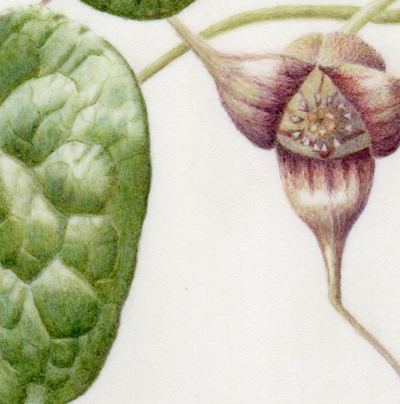
Thumbnail view of Wild Ginger painting on calfskin vellum, work in progress
Once I start a painting, I like to keep the momentum going and finish as soon as possible, but sometimes life intervenes. Even though I didn’t have time to finish the painting this spring for a variety of reasons, I’ve tried to use the intervening time to get to know the plant better by tracking it’s seasonal changes. For instance, it developed some interesting seedpods over the summer, which I dissected and documented for future reference. When I paint a plant, I think of it as a portrait, so I want to include as much information about the character of that plant as I can, as any good portrait painter seeks to do. My hope is to engage the viewer, drawing him/her in as I have been drawn in; to take a second and third look at the beauty and intricacy of even seemingly ordinary things in nature.
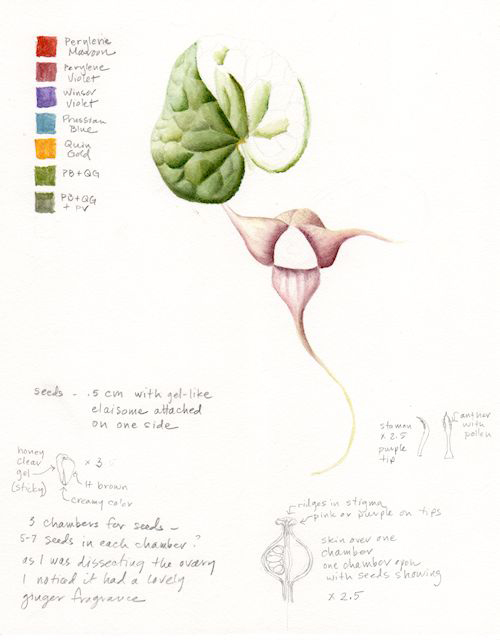
For future reference, I use my sketchbook to record information about the plant and the pigments I’ve used in my painting. Sometimes I do a trial run on the important parts of the painting like I did here.
After getting back from my travels last week, I parted the ginger leaves and was delighted to see several buds and blossoms hiding below–it was blooming out of season! So I am excited about resuming work on it now rather than later. I’ll be able to use the dissections in the composition as well.
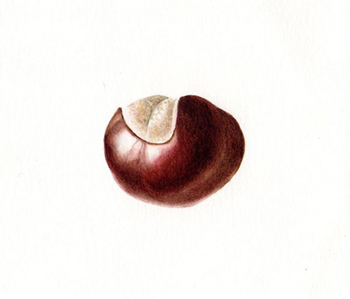
After one of these chestnuts bounced off my car, I understood why the Brits call them “conkers”!
To get my self back into the painting mode, I did some quick studies of a chestnut and a fig. I was inspired by a daily painting challenge during the month of September in an online forum of botanical artists that I belong to on Facebook. I was away for most of the challenge but got in at the end with my two little pieces. It felt good to work quickly on scrap paper without any expectations other than to learn. It was a fun and rewarding little exercise.
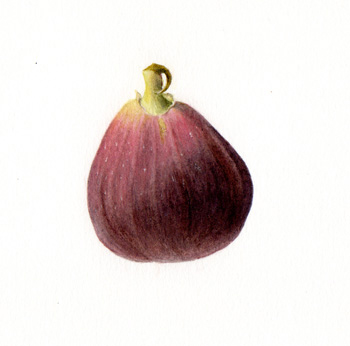
This fig was at its peak of ripeness–the great thing about painting fruit is that you get to eat it afterwards!
Now I am ready to finish what I started last spring!


 This blog is about my journey as a botanical artist--what I am learning, what inspires me and what I am currently drawing or painting. My desire is to continually hone my skills to better express my wonder and gratitude for the beauty of the creation around me in the Pacific Northwest (USA).
That wild ginger looks like it will be an amazing painting. I can totally relate to what you say about it being a plant portrait and wanting to understand the character of the plant. I love the chestnut and the fig, especially the fig (but don’t tell Giovanni)!
Shevaun, Well, you started the free-for-all at the end of the September challenge, so you were my inspiration for the chestnut…and the fig too! I hope that I will be around to go through the whole month next year.
I like seeing the work in progress of your ginger sketch. The highlights and shading are remarkable. The fig looks, soft, plump and ready to eat. The painting that impresses me the most, though, is the chestnut. Having tried painting a few of those last week, I know how difficult it is to represent the irregular curves of the husk, the mottled white part, and the shiny reflections. Wow!
Vicky, I thought the fig would be a lot harder than it was and the chestnut would be easier! It looks so simple a first glance, but there is a lot more after examination. Glad you like the result of my efforts. I had fun with it.
The ginger is going to be amazing when you can finish it considering how good it looks already.
I love conkers. What a great painting!