

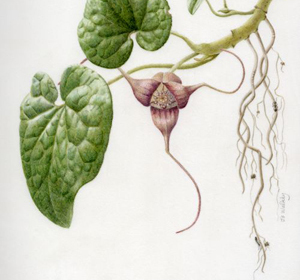
What are the essential things to know about Wild Ginger (Asarum caudatum), and how to present them in a simple yet artful way? That was what I asked myself when planning this plant portrait. I edited my initial drawings until they were stripped of anything I thought extraneous.

Wild Ginger watercolor on calfskin vellum; 1 1/2 x life size
First, it’s a low, ground cover that creeps along the ground with rhizomes that root as they extend themselves, so roots and at least one small branch should be included. Second, the flamboyant flowers sit under the leaves, as if they are waiting to surprise those who seek them out, so that should be shown in the composition. Then the glossy yet hairy texture of the leaves and flowers…

The hairy yet glossy leaves and flower close-up
…and the ants. Wild Ginger is propagated by ants in an amazing way, which I wrote about here. Basically the ants grab onto a fatty handle-like appendage on the seed and drag it to their nest, where the larvae eat away this nutritious appendage. Then the ants take the seed to their underground garbage dump, where it eventually sprouts and starts a new ginger colony. I had planned to add some seeds and flower dissections but decided to save those for another painting. The ants in this painting hint at the rest of the plants story and that is enough for now.

An ant, roots and hairy petals…part of the story of Wild Ginger.
The only essential that I couldn’t include in my painting is the lovely fresh lemony-ginger fragrance that fills the air when any part of the plant is cut or bruised. No wonder native peoples of the Pacific Northwest used the boiled and crushed leaves in their bath water to sooth arthritis or just as a protective wash. They also made tea with the rhizomes to treat an upset stomach. The roots were also used as a poultice for headaches or joint pain. Interestingly, the roots have been shown to have antibiotic properties.
I suddenly have a yen for a steaming cup of my favorite tea…lemon-ginger anyone?


 This blog is about my journey as a botanical artist--what I am learning, what inspires me and what I am currently drawing or painting. My desire is to continually hone my skills to better express my wonder and gratitude for the beauty of the creation around me in the Pacific Northwest (USA).
Beautiful work Janene, your leaves are exquisite. Very interesting plant too!
Thank you so much, Vicki! Glad that found found the plant interesting too.
Really fascinating to read this, Janene. I’m looking forward to seeing the next painting too!
Thank you, Shevaun–I appreciate your comment!
Janene, I think you met each of your goals when you painted this piece and result is exquisite.
I’m fascinated by the intricacy of the leaves, the tiny hairs, and the graceful roots–all that you captured masterfully. The ant story was an extra bonus!
Vicky, the plants quirks and characteristics unfolded before me as i studied and painted it, and it was an enjoyable journey…and fun to share with others. The ants were a bonus to me too. I loved learning about them.
This was great to read Janene and your artwork so beautiful too. Symbiosis in the natural world is fascinating – wouldn’t that be an exciting theme for artwork ? 🙂
Thank you much, Sarah! I agree that symbiosis would make an exciting theme…I want to bring it into my work more in the future…and the bonus is that I get to paint more ants!! Yay!
I love the leaves in this one Janene – really beautifully done. Such wonderful use of tone.
Thanks Jess, that means a lot coming from such a leaf master as yourself!
Stunning! Love how the ants worked out.
Thanks Sue–the ants were so much fun to do!! I can’t wait to try more insects.