


Dropping crumbs onto the ant trail became our entertainment during picnics last summer, my granddaughter and I. We were entranced by the suspense of seeing whether the ant would be able to lift the massive (in ant terms) crumb by itself or would it go recruit helpers? How would the ant team deal with getting the big crumb into the tiny hole that led to their nest? How long would they tug before a smart one would come long and take a bite to begin transporting it down bit by bit? Such drama–I hadn’t slowed down enough to watch ants since childhood. Hanging out with a three year old is a great way to be reminded of the wonder of ordinary things.
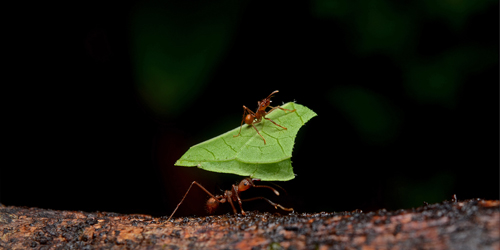
An ant showing off its super strength. photo courtesy of Geoff Gallice
Since I had been thinking about ants anyway, my ears pricked up when I read that the plant I am currently painting, Wild Ginger, is propagated by ants. The seeds have an elaiosome, which is a sort of fatty handle attached to the seed. The ants carry it to their nest to feed their larvae. After the elaiosome is consumed, they take the seed to their trash pile (I’m not kidding) which is the perfect rich environment for seed germination and growth.
I decided that the elaiosome and ant dispersal is an important part of this plant’s story, so should be included in my painting. I wanted to depict my ant accurately so drew some magnified versions to help me understand ant physiology better. I used reference photos from the web after many failed attempts to take my own. (Why won’t ants stand still for just a moment?) The educational websites Discover Life and Bug Guide have been helpful, and the insect photos of biologist, Alex Wild, have been an awe-inspiring aid! So an ant, reduced to be in scale with the plant of course, will be appearing somewhere in my painting. Maybe I could have a find the ant contest…?
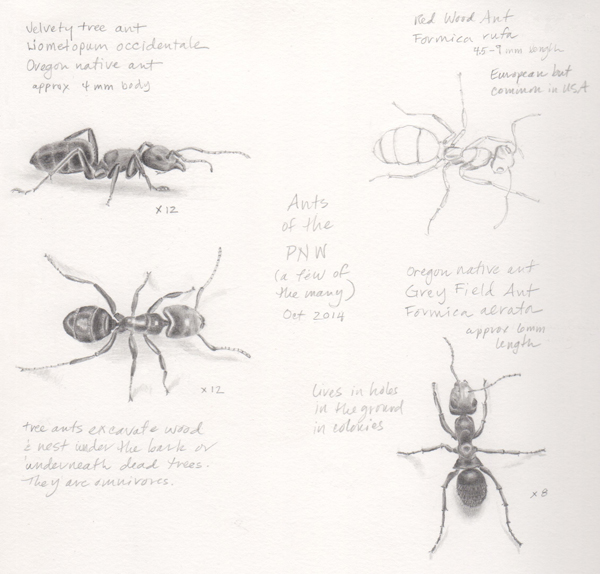
My drawings and notes about ants commonly found in the Pacific Northwest, where I live.
I dissected a ginger blossom and seed pod, and made rough drawings with notes and measurements. I plan to develop these into detailed graphite drawings to include in my wild ginger portrait as well. I also took reference photos to help jog my memory about the details. I have found that my Magnifying Glass with Light app is perfect for this purpose. It not only has an adjustable magnifying glass and light but also takes photos, which are stored in my photostream. I’ve found its wonderful for insect close-ups, at least for insects that will stay still for a moment since it takes a couple of seconds to focus. I use it record plant details while I am out in the field too. I even use it in my studio although I have a nice camera that could do the job as well. The adjustable light is nice because I can illuminate my subject to the degree I want without having to choose between the ambient light and a flash, and it is handy just to grab my phone and click away. Best of all–the app is free!!

Top view of Asarum caudatum seed beside ruler for recording measurement; bottom of Asarum seeds showing elaiosome; cross section of Asarum seed
I’ve been developing a list of other ant-propagated, or myrmecochorus, plants with the help of botanist Catherine Hovanic. I knew I had met a kindred spirit when her eyes lit up at the mention of ant-propagated native plants. I appreciate her encouragement.
You never know, maybe this ant propagation theme will become a series…you might say I have the elaiosome bug…


 This blog is about my journey as a botanical artist--what I am learning, what inspires me and what I am currently drawing or painting. My desire is to continually hone my skills to better express my wonder and gratitude for the beauty of the creation around me in the Pacific Northwest (USA).
Wonderful post and super sketches! I’ve been fascinated too by these tiny creatures, except for the nasty ones that bite!! Still, they can carry out a great role.
Thanks, Shevaun! I know what you mean, they are fascinating but not exactly cuddly. Those tiny pincers can make their presence known…ouch!
How interesting the ant dispersal is and I think you are right to include one in your forthcoming painting. The ant studies are fantastic.
Thanks Sue, Good to hear from you! I hope all is well with you. I just visited your blog and noticed that you went to the symposium in Brazil–it looks wonderful from your sketches. I didn’t have time to comment but will return.