


At one time, Camassia meadows stretched over many acres in the Willamette Valley, looking like lakes of clear water from a distance according to the early explorer, Meriwether Lewis. Camassia quamash or Camas lilies grow in the Oak savannas of the Pacific Northwest, along with many other wild flowers.
Camas lily bulbs were a staple of Native American diet, and Lewis and Clark even noted that Nez Pierce Indians saved their expedition from near starvation with a meal including the bulbs. Traditionally, they were harvested with sharp sticks by the women of the tribe, then cooked for up to 2 days in a pit. After this long period of cooking the formerly indigestible and unpalatable bulbs reportedly become sweeter than sweet potatoes with a pleasant pear flavor. They were dried into cakes and eaten year around, and even used in trade with other tribes. The tribes highly prized their Camassia meadows, and cultivated them by weeding and periodic burns to keep out encroaching shrubs. They would harvest only the large bulbs and return the smaller ones to the ground to insure the continuation of the meadow.
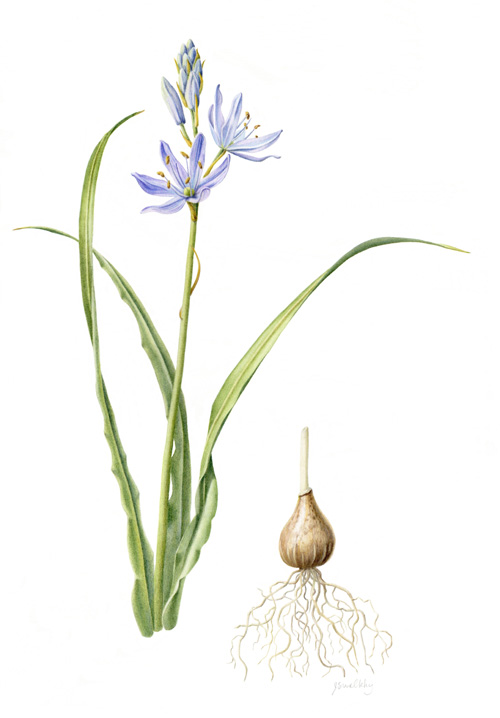
Painting the Camas lily was challenging because the blossoms seemed to change color according to the time of day and brightness of the light, sometimes looking quite blue and others more violet. I tried to capture the shifting colors in my painting by applying delicate violet washes where the sun shone through the blue petals. I included the bulb because it is an important part of the story of the plant.
Recently, I got to hike through one of the few remaining Camassia meadows in a little known area on a bluff along the Columbia River. The blue blossoms covered the top of the bluff in a thin strip that extended as far as I could see.
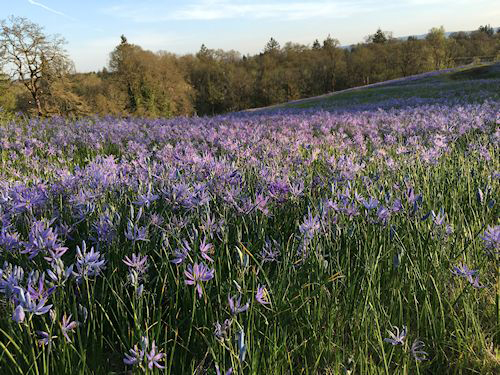
In the Pacific Northwest, a few Camassia meadows survive on rocky bluffs , where agriculture and development are difficult.

A Camassia meadow with patches of Desert Parsley or Lomatium utriculatum.
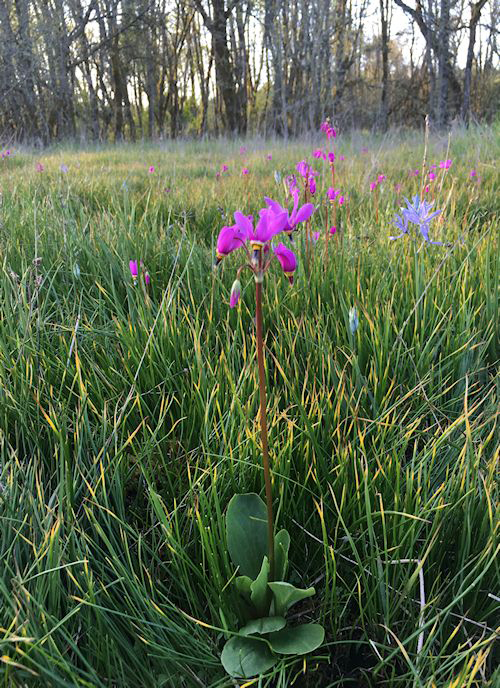
Many other wildflowers grow in these meadows, like the charming Shooting Star or Dodecatheon pulchellum.
While I am glad that at least a few of the meadows are being preserved, like the Camassia Natural Area and in Lacamas Park in Washington, I hope that more people will become aware of these beauties and strive to protect the remaining Oak savannahs of the Pacific Northwest where Camas lilies and many other wildflowers thrive.


 This blog is about my journey as a botanical artist--what I am learning, what inspires me and what I am currently drawing or painting. My desire is to continually hone my skills to better express my wonder and gratitude for the beauty of the creation around me in the Pacific Northwest (USA).
Your photos of the Camassia meadows are beautiful and in their vulnerable state are like our bluebell woods which have declined hugely and are now being threatened by an invasion of Spanish bluebells – escapees from people’s gardens – which are hybridising with the wild ones. There are few things more lovely than a beech wood in early spring, carpeted with scented bluebells.
Hi Angela, I have always admired photos of England’s bluebell woods and longed to see them in person. I had no idea that they were threatened. I have Spanish bluebells in my garden, a gift from a previous owner, so I know how invasive they are…and difficult to get rid of. I hope efforts to protect your bluebell woods and our meadows will be successful. Thanks for your comment.
This blog is really super. I love your picture and the ones of the Camassia fields. They are amazing. I have done a Camassia in CP and have them growing in my garden. This year they have increased in number, so I am very pleased with my patch of ‘blue stars’.
Hi Gaynor, How interesting that you grow Camassia and have illustrated them too! I bought some in pots to use as reference for my painting but will plant them in my garden and hope for the best. Thanks for your comment–I am so happy that you like my blog!
What a wonderful illustration and story! I always enjoy how you combine the history of each plant into your posts!
Thanks, Debo! Aren’t plants fascinating? I love to learn about the part they play in the web of life, and am so glad that others find it interesting too!