

Botanical subjects have no end of challenging textures, from fuzzy buds to craggy bark, so I was delighted to be able to take a two-day workshop on “Painting Realistic Textures in Watercolor” by Denise Walser-Kolar to shed some light on the topic. The workshop was hosted by the Pacific Northwest Botanical Artists at the University of Washington Center for Urban Horticulture in Seattle, which is about a 3 hour drive from my home in Portland.
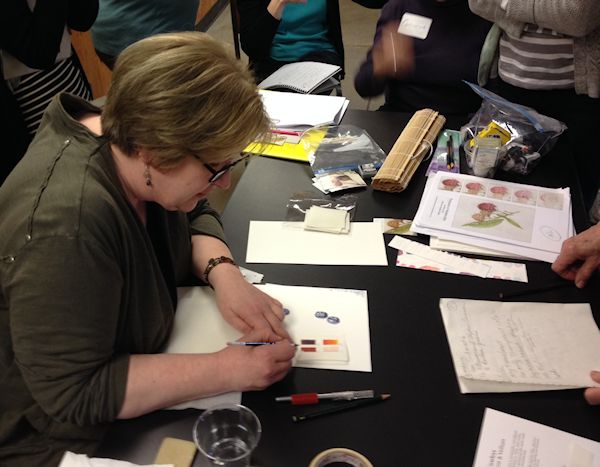
Denise Walser-Kolar demonstrating her technique to the class.
By the end of the second day of the workshop, we were all remarking on how quickly and enjoyably the time had gone by, and how much we had learned! Talent and skill doesn’t always translate into being able to teach what one knows, but Denise is one of those rare jewels who is both a talented artist and teacher. I am not going to try to recount all that she covered, but if you want to know, I hear she is teaching the same workshop at the ASBA conference in Denver in September. I highly recommend it!
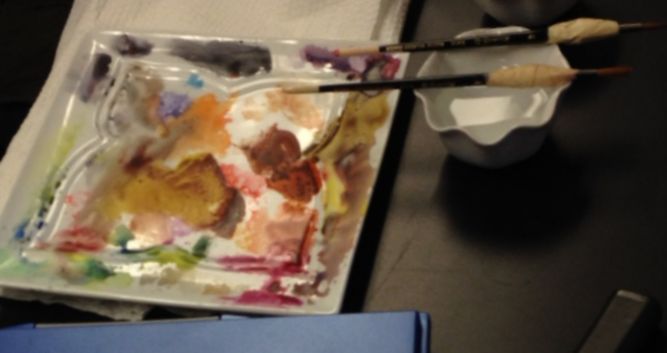
Denise’s palette of swished colors
Since I have learned botanical art mostly through trial and error and written descriptions of technique, one of the features of the workshop that I found most helpful was simply watching her demos. Her palette alone is a work of art. She chooses the pigments for her subject, then gently swishes them around on a porcelain plate so they barely intermingle in different combinations. In this way she creates an amazing array of colors and shades to choose from that all blend beautifully in the painting because they are related to one another.
If I remember correctly, for this palette ‘abstract art’ she daubed a bit of Prussian Blue, French Ultramarine and Winsor Yellow then danced her brush around here and there and viola, peaches, browns, purples, and rich greens emerged. Although she almost exclusively uses transparent colors, she daubed on a bit of opaque Neutral Tint (upper left corner), after her palette had dried, to use at the end of the painting in a small area for the darkest dark. She pointed out that you can’t achieve really deep darks with transparent colors even with layering. She didn’t mix the Neutral Tint in with the other colors on the palette, and applies it last in her paintings so it doesn’t bleed into her beautiful transparent colors.
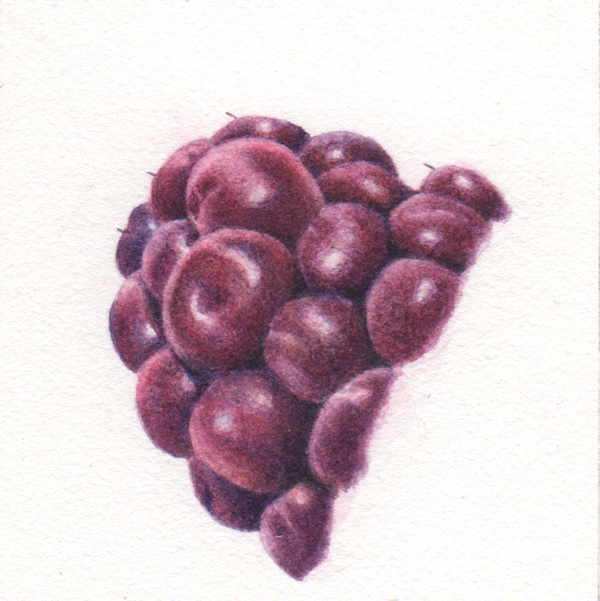
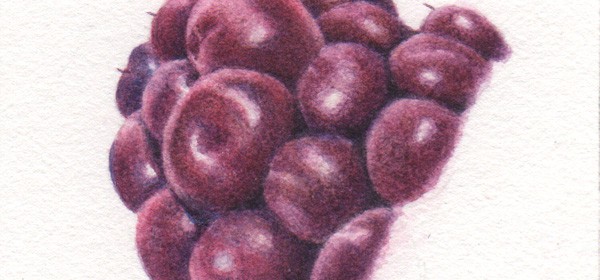
My half of a berry painted for shiny and smooth (and bumpy too) texture practice.
She uses the dry brush technique so picks up the ‘skim’, or thin layer of dried paint on her palette, with a barely damp brush, then applies it to her painting in small strokes. She had us use Strathmore 500 series Bristol paper with vellum finish. I have not painted on Bristol paper before, although I often use it for drawing, and found it quite different from the Fabriano Artistico Hot Press that I usually use. The Bristol paper was very tough and could take a lot of abuse–it even withstood using an electric eraser to lift a highlight (after the paint had dried overnight) which was a technique recommended for emergencies only. The Bristol paper had a subtle grid pattern in it which I found distracting, so I think I will stick with the smooth HP paper but it was interesting to try something new.
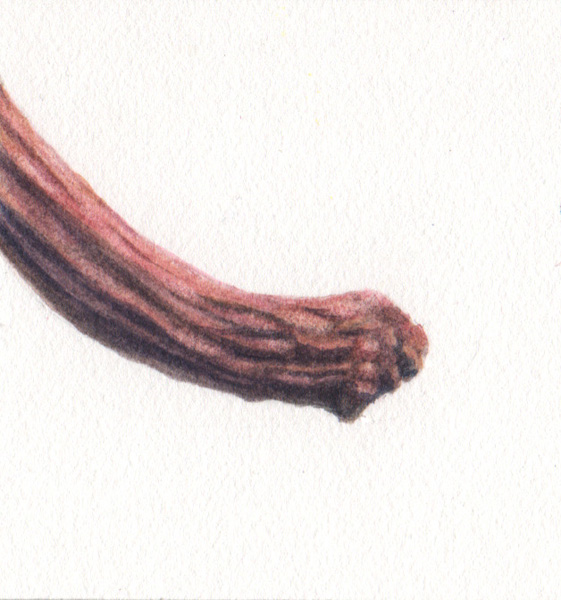
A stem that I painted for dry and withered texture practice
She had us draw six small squares (mine were about 2×2″ or 6x6cm), and gave us photos of various textures found in plants and instructions on how to achieve each one. As usual, I was very slow so only got partway through two of my squares! I actually had to finish them at home. When I get ready to paint something with the other textures, I’ll get out the handout she gave us to refresh my memory on how to approach the task.
I enjoyed getting to know the Seattle group a bit better as well and hope to join them again for future workshops or events.


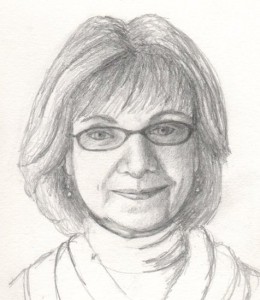 This blog is about my journey as a botanical artist--what I am learning, what inspires me and what I am currently drawing or painting. My desire is to continually hone my skills to better express my wonder and gratitude for the beauty of the creation around me in the Pacific Northwest (USA).
Dear Janine thank you for sharing your impressions of the course with Denise Walser-Kolar .
A huge hug!
Simone, You are so sweet–thank you! x